

Canadian parents pay anywhere from $200 to $1,800 per month for full-time daycare in 2026, depending on the province, the child’s age, and whether the facility is subsidized. That gap reflects one of the biggest ongoing challenges facing the Canada economy: affordable childcare directly shapes whether parents, especially mothers, can return to work after having children.
Provincial differences drive most of the variation. Quebec maintains the lowest fees thanks to decades-old subsidized programming, while families in Ontario and British Columbia often face the steepest bills. Federal childcare agreements signed in recent years aim to bring costs down to $10 per day in participating provinces, but implementation timelines and availability differ widely. Some families already benefit from reduced rates, while others remain on waitlists.
Beyond geography, age matters. Infant care costs considerably more than care for toddlers or preschoolers because licensing rules require higher staff-to-child ratios. Private centers charge premium rates for extended hours, meals, and structured programming. Non-profit and home-based providers tend to price lower but may have limited spots.
For families weighing childcare decisions, understanding what drives these costs and where savings exist is essential. This article breaks down provincial pricing, explains what fees actually cover, identifies the variables that push rates higher or lower, and compares professional daycare with alternative care arrangements.
Daycare Costs Across Canadian Provinces and Territories

Daycare fees in Canada vary dramatically depending on where you live. A family in Quebec might pay $200 per month for infant care, while the same spot in Ontario could cost $1,800, a difference that fundamentally shapes whether returning to work makes financial sense for many mothers.
The 2026 landscape shows significant provincial variation despite federal efforts to reduce fees. Quebec has maintained the lowest rates for decades through its heavily subsidized system. Manitoba, Yukon, and Nunavut have achieved substantial reductions under the Canada-Wide Early Learning and Child Care agreements, bringing infant care below $500 monthly in some regions. Meanwhile, provinces still rolling out fee reductions, including Ontario, Alberta, and parts of Atlantic Canada, show higher rates, particularly in urban centres where demand outstrips supply.
| Province/Territory | Infant (0-18 months) | Toddler (18 months-3 years) | Preschool (3-5 years) |
|---|---|---|---|
| Quebec | $200 | $200 | $200 |
| Manitoba | $450 | $380 | $350 |
| Ontario (Toronto) | $1,800 | $1,500 | $1,250 |
| Alberta (Calgary) | $1,200 | $1,050 | $950 |
| British Columbia (Vancouver) | $1,400 | $1,200 | $1,000 |
| Yukon | $350 | $300 | $275 |
These cost gaps create different economic realities for women weighing employment decisions. In Quebec, daycare costs rarely exceed 10% of household income, making the return-to-work calculation straightforward for most families. A mother earning $45,000 annually keeps the vast majority of her income after childcare expenses.
The math shifts dramatically in higher-cost provinces. An Ontario mother earning $50,000 gross pays roughly $35,000 after tax, but faces $21,600 in annual infant daycare costs, consuming 61% of her take-home pay before accounting for commuting, work clothing, or meals. Add a second child, and the entire salary disappears into childcare fees. Many women in this position rationally choose to pause careers, particularly when factoring in lost pension contributions and career advancement opportunities during their absence.
Urban versus rural divides compound provincial differences. Toronto daycare costs run 40% higher than rates in Thunder Bay. Vancouver’s fees exceed Kelowna’s by similar margins. Women in smaller communities often find more affordable care, though job opportunities may also be limited. The intersection of regional labour markets and daycare costs creates a complex calculation that varies neighbourhood by neighbourhood, not just province by province.
What Your Daycare Fee Actually Covers
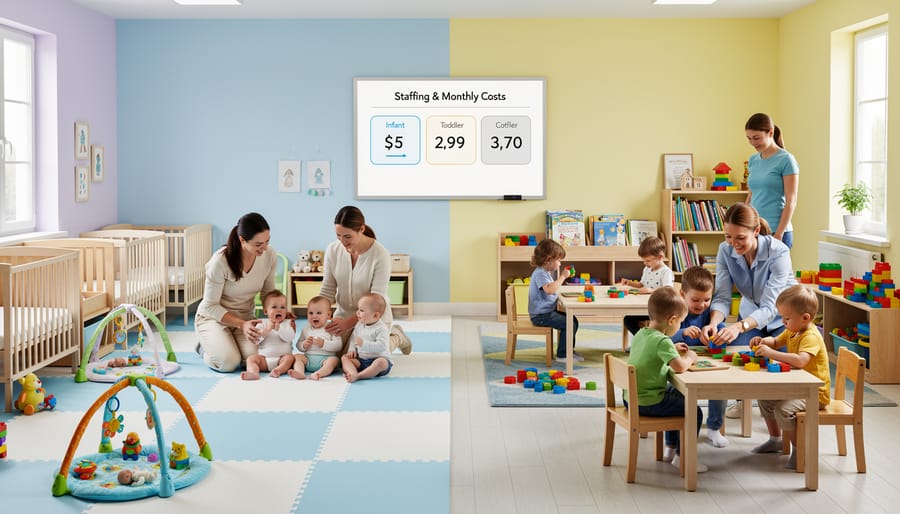
When you write a cheque for $1,200 or $2,000 each month, you’re not just paying for a spot on the floor. Daycare fees cover a complex operation with multiple overhead layers, and understanding the breakdown helps explain why rates sit where they do.
Staffing typically eats up 60 to 70 percent of your monthly fee. Licensed daycares must maintain strict staff-to-child ratios, often one adult for every three infants or four toddlers, which means more employees per child than you might expect. Those salaries include early childhood educators with formal credentials, assistant teachers, and sometimes specialized staff for meal prep or administration. Benefits, payroll taxes, professional development, and background checks add further layers to labour costs.
Facility expenses form the next major chunk. Rent or mortgage payments for dedicated childcare space, especially in urban centres where real estate runs high, can represent 15 to 20 percent of operating costs. On top of that, centres pay for utilities, property insurance, maintenance, cleaning supplies, and safety upgrades like secure entry systems and playground equipment repairs.
Your fee also funds the day-to-day necessities that keep your child fed, engaged, and learning:
– Meals and snacks prepared on-site or catered, meeting nutritional guidelines and accommodating allergies
– Educational materials including books, art supplies, puzzles, and age-appropriate learning tools
– Consumable supplies such as diapers, wipes, paper products, and cleaning materials
– Program licensing fees and mandatory inspections to maintain provincial accreditation
– Liability insurance protecting the centre, staff, and enrolled families
– Administrative costs for record-keeping, payroll processing, and parent communication systems
Educational programming deserves its own mention. Quality centres invest in curriculum development, training workshops for staff, and learning resources that align with early childhood frameworks. Some programs bring in music instructors, offer language immersion, or provide specialized activities, all factored into your monthly rate.
Administrative overhead rounds out the budget. Directors, office staff, accounting, legal compliance, and technology systems for attendance tracking and parent updates all require funding. Even marketing to fill vacancies and manage wait lists costs money.
The bulk of what you pay goes directly into the people caring for your child and the environment keeping them safe. There’s little fat in most daycare budgets; the high fees reflect genuine operating realities rather than padded margins.
Factors That Change What You’ll Pay

Age-Based Pricing Differences
Infant care typically costs 30-50% more than toddler or preschool rates across Canada, with the price gap rooted in regulatory requirements and operational realities.
The main driver is staffing ratios. Provincial regulations require one caregiver for every three to four infants, compared to one caregiver for eight to ten preschoolers. A Toronto centre charging $2,000 monthly for infants might charge $1,400 for toddlers and $1,200 for preschoolers, reflecting the labour cost difference.
Infant rooms also demand more intensive care. Frequent diaper changes, bottle preparation, individualized feeding schedules, and one-on-one attention consume staff time that older children don’t require. Facilities must maintain separate sleeping areas meeting strict safety standards, stock specialized supplies like formula and infant-specific cleaning products, and often hire staff with additional infant care certifications.
The gap narrows as children age. Once a child transitions to the toddler room around 18 months, monthly fees typically drop $300-600. Another decrease occurs at age three when preschool ratios allow centres to serve more children per educator, lowering the per-child cost while maintaining quality care.
Location and Facility Type Impact
Urban centres command premium daycare rates due to higher operational costs. In Toronto or Vancouver, you’ll pay 30-50% more than in smaller cities for the same quality of care. A downtown Toronto centre might charge $2,200 monthly for infant care, while a comparable facility in Thunder Bay runs $1,400. Property costs, staff wages tied to local living expenses, and regulatory compliance fees all push urban rates higher.
Facility type creates another price split. Licensed centre-based daycares typically cost $1,400-$2,000 monthly for toddlers in mid-sized cities. Home-based licensed daycares operating from residential properties run $900-$1,300 for the same age group. The savings come from lower overhead, no commercial lease, smaller staff ratios, fewer administrative layers.
But cheaper doesn’t mean inferior. Many home daycares offer excellent care in smaller, family-like settings. Centres provide more structured programming and backup staff when someone’s sick. Your choice depends on what matters more: cost savings or the resources a larger facility brings. Both options meet provincial licensing standards, so you’re comparing operational models, not safety or legality.
Enrollment Schedule and Additional Fees
Full-time enrolment typically costs 15-25% less per day than part-time schedules. A centre charging $1,400 monthly for five days a week might ask $950 for three days, making the daily rate higher for part-time families. Some facilities refuse part-time spots entirely when demand is strong.
Beyond monthly fees, expect registration charges of $50, $200 annually. Meals add $5, $10 per day if not included. Field trips, special activities, and supplies can tack on another $20, $50 monthly. Late pickup fees start around $1 per minute after closing. These extras quickly inflate your actual cost, so ask for a complete fee schedule before enrolling. Some centres bundle meals and activities into one rate, which simplifies budgeting but may cost more upfront.
Licensed Daycare vs. Alternative Childcare Options
Unlicensed Home Daycare
Unlicensed home daycares typically charge $600 to $900 monthly for infant care and $500 to $800 for toddlers, roughly 30 to 50 percent less than licensed centres. These providers operate from private homes without provincial licensing, which means no mandatory staff-to-child ratios, no inspections, and no curriculum oversight. For working women balancing tight budgets, the lower cost can make continued employment financially viable, but you trade regulatory protection for affordability. Quality varies widely: some unlicensed caregivers are experienced and nurturing, while others lack training or adequate supervision. You won’t qualify for government subsidies in most provinces, and liability coverage is often absent. Before enrolling, visit the home multiple times, ask for references, check police record checks, and trust your instincts, price savings mean nothing if your child isn’t safe and well cared for.
Nannies and Nanny Shares

Hiring a nanny full-time in Canada typically costs $2,500 to $4,000 per month depending on experience, location, and whether you provide benefits. Urban centres command higher rates, expect $18 to $25 per hour in Toronto or Vancouver, translating to roughly $3,100 to $4,300 monthly for standard full-time care. Live-in nannies may accept lower hourly wages in exchange for room and board, but total compensation including accommodations often reaches similar levels.
Nanny shares, where two or three families split one caregiver’s salary, reduce individual costs substantially. Each family usually pays 60-70% of what they’d pay for exclusive care, bringing monthly expenses down to $1,500 to $2,400 per child. You’ll need compatible schedules and parenting approaches, plus clear agreements on sick days, holidays, and household responsibilities.
Unlike daycare centres, nanny arrangements require you to handle payroll taxes, employment insurance, and CPP contributions as the employer. Budget an additional 10-15% of wages for these obligations. The flexibility and one-on-one attention appeal to many families, but administrative complexity and higher overall costs make nannies less common than centre-based care for single-child households.
Family Care and Staying Home
When daycare fees approach or exceed your take-home pay, staying home or relying on grandparents or relatives starts looking like the only rational choice. A parent earning $45,000 annually takes home roughly $3,000 monthly after taxes and deductions. If daycare costs $1,800 to $2,200 per month, you’re working for what amounts to $800 to $1,200 in disposable income, before factoring in commuting costs, work clothes, and the stress of juggling schedules.
Many families turn to grandparents or other relatives for childcare, which eliminates monthly fees but introduces different costs. You’re asking family members to commit significant time and energy, which can strain relationships if expectations aren’t clear. Grandparents may have their own health limitations, travel plans, or simply prefer being grandparents rather than full-time caregivers. And if you’re relying on this arrangement long-term, there’s no backup plan when your family caregiver gets sick or needs a break.
Leaving the workforce entirely means zero childcare costs but creates a growing gap in your resume and lost career advancement opportunities. You also forfeit employer pension contributions, CPP credits, and salary increases that compound over time. A three-year career break for someone earning $50,000 annually can mean $200,000 or more in lost lifetime earnings when you account for raises and retirement savings you would have accumulated. That calculation gets even more painful if you’re in a field where skills become outdated quickly or where re-entry requires starting several rungs lower on the career ladder.
Government Subsidies and Fee Reduction Programs
The federal Canada-Wide Early Learning and Child Care (CWELCC) agreements have transformed daycare affordability since launching in 2021, with 2026 marking a milestone year as most provinces achieve the $10-a-day target. Under these agreements, the federal government transfers funding to provinces and territories to reduce parent fees at licensed daycare centres, making childcare accessible enough for more mothers to remain employed without losing most of their earnings to care costs.
Provincial implementation varies, but the savings are substantial. In provinces that have fully implemented the program, families now pay around $200 per month instead of $1,000 or more for infant care. British Columbia hit the $10-a-day threshold in 2024, while Ontario rolled out progressive reductions bringing average fees to roughly $300 monthly by early 2026. Quebec maintains its longstanding subsidized system at approximately $9.10 per day for regulated spaces. These reductions have proven critical for women’s workforce participation, studies show that when childcare costs drop below 20% of household income, mothers’ return-to-work rates increase by 15-20%.
Beyond CWELCC, targeted subsidy programs help lower-income families:
- Federal Canada Child Benefit provides up to $7,437 annually per child under six (income-tested), offsetting childcare costs for families earning under $34,863
- Provincial top-up subsidies in most regions cover additional fees for families below provincial income thresholds, often reducing costs to zero for households earning under $30,000
- Ontario’s Child Care Fee Subsidy covers the difference between CWELCC rates and actual fees for eligible families, with priority for single parents and those on social assistance
- Alberta’s Child Care Subsidy provides sliding-scale support based on family size and income, with maximum benefits reaching $550 monthly for infant care
- Manitoba’s Early Learning and Child Care Benefit offers income-tested grants directly to families, averaging $200-400 monthly for qualifying households
Eligibility typically requires Canadian citizenship or permanent residency, proof of income below provincial thresholds (usually $50,000-$80,000 for partial subsidies), and enrollment in a licensed facility participating in the childcare policy agreements. Application processes vary by province but generally involve submitting income verification, employment confirmation or proof of job search, and the child’s birth certificate through online portals or municipal offices.
Processing times range from two weeks in streamlined provinces like BC to two months in regions with backlogs. Once approved, subsidies apply retroactively to the application date, and families must renew annually with updated income documentation. The combination of CWELCC fee reductions and income-tested subsidies means most Canadian families now pay less than 10% of household income for regulated childcare, a dramatic shift that has enabled thousands of women to re-enter or remain in the workforce.
The Employment Equation: When Daycare Costs Make or Break Working
For many Canadian families, daycare costs don’t just strain the monthly budget, they fundamentally reshape employment decisions, particularly for mothers. When a second parent’s take-home pay barely exceeds childcare fees, the question becomes whether working makes financial sense at all. This calculation has profound implications that extend far beyond the immediate balance sheet.
The break-even analysis is deceptively simple on paper but emotionally complex in practice. A parent earning $45,000 annually takes home roughly $35,000 after taxes and deductions. With average full-time infant care costing $1,200 to $1,500 monthly in many urban centres, that’s $14,400 to $18,000 yearly, potentially half of net income before accounting for commuting costs, work clothing, and convenience meals. For families with multiple children in daycare simultaneously, the math becomes even starker. Some mothers find themselves working primarily to maintain benefits coverage and career continuity rather than generating meaningful household income in the short term.
This financial pressure intersects directly with the existing gender wage gap creating a compounding effect. Because women’s earnings average 87 cents for every dollar men earn in Canada, mothers are more likely than fathers to be the “lower-earning” spouse whose income gets weighed against daycare costs. This dynamic perpetuates workforce inequality: families default to having the mother stay home not because of preference or capability, but because her salary makes the smaller dent in childcare expenses.
How do I calculate if working covers daycare costs?
Subtract your annual take-home pay (after taxes, not gross salary) from total yearly daycare fees plus work-related expenses like commuting and parking. If the remaining amount seems minimal, factor in whether you’re maintaining benefits, pension contributions, and career progression that have long-term value beyond immediate income.
What are the long-term costs of leaving the workforce for childcare?
A five-year career break can reduce lifetime earnings by 20 percent or more through lost salary progression, missed promotions, skill depreciation, and reduced pension contributions. Many women who leave find re-entry difficult, often returning at lower positions or pay grades than where they left.
Does subsidized daycare actually increase women’s workforce participation?
Yes, significantly. Quebec’s subsidized childcare program increased mothers’ labour force participation by 8 percentage points, demonstrating that affordable care directly enables women to remain employed.
The long-term career consequences of stepping away extend well beyond the years spent at home. Mothers who leave the workforce for three to five years face steeper re-entry challenges: skills become dated, professional networks atrophy, and employers view resume gaps skeptically. Even those who successfully return often do so at reduced seniority or compensation levels. The cumulative effect on lifetime earnings, retirement savings, and career advancement can reach six figures.
At the macro level, these individual decisions aggregate into substantial economic impact. When childcare costs push mothers out of the labour force, Canada loses productive capacity, tax revenue, and the full utilization of its educated workforce. Economists estimate that every dollar invested in reducing childcare costs generates broader economic returns through increased employment and tax contributions. The provinces that have implemented subsidized daycare programs haven’t just supported families, they’ve unlocked labour force participation that benefits the entire economy.
Daycare Cost by Key Factor

Daycare costs in Canada shift substantially based on three primary variables. Child’s age drives the steepest price differences: infant care (0-18 months) typically runs $1,200, $1,800 monthly in major cities, while toddler care drops to $1,000, $1,400, and preschool-aged children cost $900, $1,200. The gap reflects mandated staff-to-child ratios, infants require one caregiver per three or four children versus one per eight for preschoolers, directly inflating labour expenses.
Geographic location creates dramatic variance. Toronto and Vancouver average $1,500, $2,000 monthly for infant care, whereas smaller centres like Moncton or Thunder Bay charge $700, $1,000 for the same service. Provincial subsidy frameworks compound these differences; Quebec’s regulated system keeps fees around $190, $220 monthly across ages, while Alberta families pay full market rates without universal caps.
Facility type completes the cost equation. Licensed centre-based programs charge 20-40% more than licensed home daycares due to higher overhead, commercial rent, administrative staff, liability insurance. Unlicensed arrangements cost less still but sacrifice regulated safety standards. Track policy shifts through 2026 updates as federal-provincial agreements continue reshaping provincial pricing structures.
What Changes the Price
Daycare pricing responds to several economic and operational forces beyond the basic variables of age, location, and schedule. Staff qualifications drive costs upward: centres employing early childhood educators with post-secondary credentials pay higher salaries, which translate to higher fees. Staff-to-child ratios matter too, provinces with stricter ratio requirements force centres to hire more educators per group, increasing labour costs by 15 to 25 percent compared to jurisdictions with looser standards.
Facility ownership structure creates price differences. Non-profit centres often charge 10 to 20 percent less than for-profit operators because they reinvest revenue into programming rather than extracting profit. Conversely, for-profit chains serving high-demand neighbourhoods can command premium rates.
Wait-list pressure inflates prices in tight markets. When demand outstrips supply, centres raise fees knowing parents have limited alternatives. Toronto and Vancouver see this effect most acutely, with some centres charging 30 percent above provincial averages.
Finally, operating costs fluctuate with rent, utilities, insurance, and food prices. Urban centres facing high commercial rents pass those expenses to families, while rural facilities benefit from lower overhead but struggle with smaller enrollment pools to spread fixed costs.
DIY vs Hiring a Pro
In the childcare context, “DIY” means caring for your child yourself or arranging informal care through family members or friends, while “hiring a pro” refers to licensed daycare centres with trained early childhood educators.
Staying home eliminates monthly daycare fees, potentially saving $600 to $2,000 per month depending on your province, but costs you foregone income and career progression. A parent earning $50,000 annually who leaves the workforce for three years sacrifices roughly $150,000 in immediate income, plus future raises, pension contributions, and professional advancement. Women who take extended career breaks face steeper re-entry challenges and persistent wage gaps.
Licensed centres cost more upfront but provide structured early learning programs, regulated staff-to-child ratios, and developmental assessments that informal arrangements rarely match. You’re paying for professional training, curriculum planning, and accountability standards that home-based care doesn’t guarantee.
The trade-off isn’t purely financial. Licensed care offers socialization and school readiness benefits, while staying home provides one-on-one attention and flexible schedules. For many families, the decision hinges on whether one parent’s take-home pay after daycare costs justifies remaining employed, a calculation that disproportionately affects mothers and shapes Canada’s gender employment gap.