

Canada’s political landscape shifted significantly when Mark Carney took office as Prime Minister in April 2025, replacing Justin Trudeau after national elections ended the Liberal leader’s decade-long tenure. Since then, Parliament has passed major legislation that signals both economic nationalism and a loosening of electoral transparency requirements. Bill C-5, enacted in June 2025 as the Building Canada Act, allows infrastructure projects like ports, pipelines, and dams deemed in the national interest to bypass certain federal laws, a direct response to tariffs imposed by US President Donald Trump. More recently, Bill C-4 passed in March 2026 with buried amendments that removed the requirement for political parties to submit personal information protection policies to the Chief Electoral Officer, retroactively deeming that safeguard never to have been in force.
These legislative changes reflect competing priorities: economic sovereignty and streamlined development on one hand, reduced privacy oversight in electoral politics on the other. Carney campaigned on equality, diversity protection, and defending democratic institutions, yet his government’s first year shows a willingness to fast-track major projects and scale back party accountability measures. The moves have reshaped how federal oversight functions, raising questions about transparency and environmental review in an era of heightened trade tensions with the United States.
What Changed: Major Political Shifts in Canada

Canada’s political landscape underwent a fundamental shift when Mark Carney assumed office as prime minister in April 2025, ending Justin Trudeau’s decade-long tenure that began in 2015. The transition marked more than a change of leadership, it signaled a new governing philosophy shaped by immediate economic pressures and evolving democratic priorities.
Carney campaigned on a platform emphasizing equality, protecting diversity, and championing rights, democracy, and the rule of law. These commitments established the framework for his government’s approach to Canada’s most pressing challenges. Yet the first year of Carney’s tenure revealed tensions between stated principles and legislative realities, particularly as his government responded to external economic threats and moved to reshape electoral rules.
The immediate catalyst for legislative action came from outside Canada’s borders. U.S. President Donald Trump’s tariffs on Canadian goods forced the new government to act quickly on economic policy, creating the conditions for Bill C-5 in June 2025. That urgency set a pattern: Carney’s administration prioritized speed and flexibility in governance, sometimes at the expense of traditional regulatory processes. By March 2026, this approach extended to electoral law itself through Bill C-4, raising questions about how the government’s platform commitments align with its legislative record.
Key Developments Reshaping Canadian Politics
1. Bill C-5: Fast-Tracking Infrastructure Amid Trade Tensions
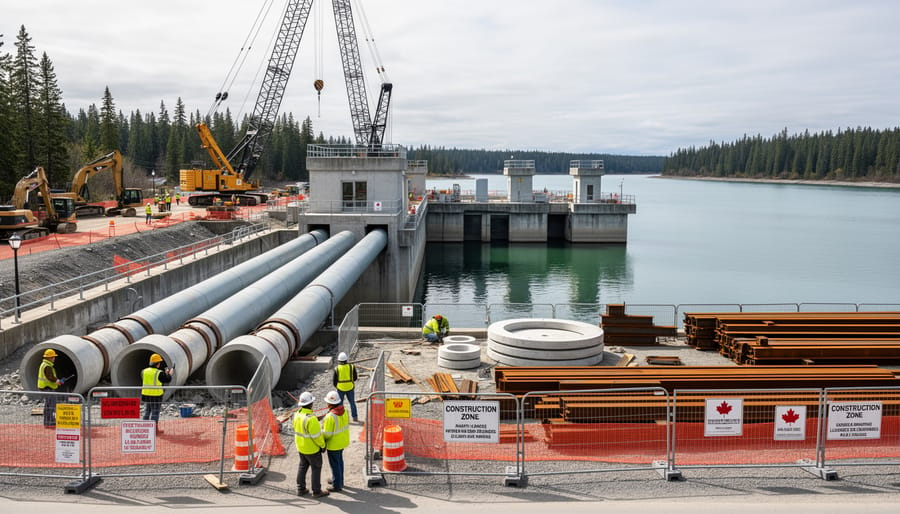
Bill C-5, formally known as the Building Canada Act, became law in June 2025 as the Carney government’s direct response to escalating trade pressures from the United States. With President Trump imposing tariffs on Canadian goods, Ottawa needed a way to accelerate economic infrastructure projects that could strengthen Canada’s competitive position and reduce reliance on cross-border supply chains. The legislation gives the federal cabinet authority to designate certain large-scale projects as serving the “national interest,” allowing them to streamline federal approvals by bypassing or modifying existing regulatory requirements.
Under Bill C-5, several categories of infrastructure can qualify for fast-tracked approval:
- Port expansions and marine terminals intended to diversify trade routes
- Oil and gas pipelines connecting resource regions to export facilities
- Hydroelectric dams and transmission corridors for energy independence
- Transportation corridors including highways and rail lines supporting inter-provincial commerce
The Act permits these projects to sidestep portions of environmental assessment processes, Indigenous consultation timelines, and various sector-specific regulations that normally govern construction and operation. Cabinet retains discretion to determine which laws apply and which can be waived on a project-by-project basis.
This regulatory flexibility has sparked sharp debate. Supporters argue that economic urgency justifies cutting red tape, especially when U.S. tariffs threaten Canadian jobs and government revenue. They contend that traditional approval processes, which can stretch years, are too slow when the country faces immediate competitive threats. Critics counter that bypassing environmental reviews and shortening consultation periods undermines democratic accountability and Indigenous rights. They warn that rushing projects forward risks environmental damage, treaty violations, and long-term costs that outweigh short-term economic gains.
The tension between economic necessity and regulatory oversight defines the current political conversation around Bill C-5, with no clear consensus on where the balance should lie.
2. Bill C-4: Electoral Law Changes and Privacy Protections

In March 2026, Parliament passed Bill C-4, legislation that quietly altered fundamental requirements for political party registration in Canada. Buried within the bill were amendments to the Canada Elections Act that removed the obligation for parties to submit a personal information protection policy to the Chief Electoral Officer as part of the registration process. More controversially, the amendments were deemed retroactive, treating the privacy policy requirement as if it had never existed at all.
The practical effect is straightforward: political parties no longer need to demonstrate how they will protect voter data, donor information, and other personal details they collect during campaigns and day-to-day operations. Before Bill C-4, parties had to file a written policy outlining their data handling practices with the Chief Electoral Officer to qualify for official registration. That safeguard is now gone, and parties already registered under the previous system are treated as if they were never subject to the requirement in the first place.
The retroactive provision raises questions about accountability. By deeming the privacy policy rule to have never been in force, Bill C-4 erases any historical record of non-compliance and shields parties from scrutiny over past data practices. Critics argue this undermines transparency at a time when voter data has become a powerful campaign tool, collected through online donations, volunteer sign-ups, and targeted outreach. Without mandatory disclosure of how parties manage that information, Canadians have less visibility into who accesses their data, how long it is retained, and whether it is shared with third parties.
The changes stand in tension with Carney’s stated platform commitment to championing democracy and the rule of law. While the government has not issued detailed public justification for removing the privacy policy requirement, the move suggests a shift in priorities around electoral regulation. As digital campaigning expands and data-driven voter targeting becomes standard practice, the absence of enforceable privacy standards for political parties marks a significant departure from the transparency framework that previously governed Canadian elections.
3. Carney’s Governance Approach: Equality and Democracy Commitments
Prime Minister Mark Carney came to office in April 2025 with a platform explicitly centered on equality and rights protecting diversity, and championing democracy and the rule of law. These commitments positioned his government as a guardian of fundamental Canadian values during a period of both domestic transition and international tension.
Yet within months, Carney’s legislative record raised questions about how those principles apply in practice. Bill C-5, passed in June 2025, grants sweeping authority to bypass federal laws for infrastructure projects deemed in the national interest, a trade-off between economic urgency and regulatory process that critics see as weakening environmental and community protections. More striking was Bill C-4 in March 2026, which retroactively eliminated the requirement for political parties to submit personal information protection policies to register. By declaring that safeguard had never been in force, Parliament erased a privacy standard without public debate.
The tension is stark: a government that campaigns on protecting democratic norms has advanced laws that concentrate executive power and roll back transparency requirements. Whether this reflects pragmatic crisis management or a broader shift in governance philosophy remains the central political debate as 2026 unfolds.
Why It Matters: Implications for Canadians
The recent political shifts under Prime Minister Carney carry tangible consequences for Canadians across multiple dimensions of daily life and governance. Bill C-5’s expedited approval process for major infrastructure projects promises faster economic response to U.S. trade pressures, potentially protecting jobs in sectors like industrial hemp manufacturing that depend on efficient supply chains. However, the trade-off involves reduced environmental review timelines and fewer opportunities for public consultation on projects that could reshape local communities for decades.
The electoral law changes in Bill C-4 alter the landscape of political transparency. Removing the requirement for parties to submit personal information protection policies, and retroactively erasing that requirement, means voters have less insight into how political organizations handle their data. This matters particularly for Canadians who donate to campaigns, sign petitions, or engage with party websites, as there’s now no mandatory framework ensuring their information is safeguarded according to consistent standards.
Economically, the government’s response to Trump-era tariffs through infrastructure acceleration aims to strengthen Canada’s competitive position. Yet the same urgency that drives these measures creates uncertainty about whether democratic safeguards and issues like the Canada gender wage gap receive equal policy attention. The tension between Carney’s stated commitments to rights and democracy versus legislative shortcuts that reduce transparency will shape how Canadians experience governance through 2026 and beyond.
What to Watch: The Political Road Ahead
As 2026 unfolds, several political fronts warrant close attention. The most immediate is whether Bill C-5’s regulatory shortcuts will face court challenges. Environmental groups and Indigenous leaders have signalled concern about projects bypassing federal environmental assessments, and legal battles over the “national interest” standard could define how far the Carney government can go in fast-tracking infrastructure. Any court ruling striking down parts of the Building Canada Act would reshape both economic policy and federal-provincial relations.
Trade tensions with the United States remain unpredictable. While Bill C-5 was designed to counter President Trump’s tariffs, the underlying dispute over trade barriers hasn’t been resolved. Watch for shifts in U.S. trade policy, or retaliatory measures from Canada, that could trigger further legislative responses or intensify economic strain on export-dependent provinces. The Canada-U.S. relationship will likely dominate headlines through the year.
Electoral transparency is another flashpoint. Bill C-4’s retroactive removal of privacy policy requirements for party registration has stirred debate about voter data protection. Opposition parties and privacy advocates may push for new safeguards, and whether the government introduces alternative privacy measures or defends the status quo will reveal much about its commitment to democratic transparency. Related policy areas, including vaping policy and other health regulations, also face scrutiny as legislators balance public safety with individual rights.
Finally, keep an eye on how the Carney platform’s stated commitments, protecting diversity, championing democracy, square with legislative action. The gap between rhetoric and policy will shape public trust and set the tone for the next election cycle.
Common Questions About Canada’s Current Political Issues
When did Mark Carney become Prime Minister?
Mark Carney assumed office as Prime Minister in April 2025 following national elections that month, replacing Justin Trudeau who had served since 2015.
What is Bill C-5?
Bill C-5, the Building Canada Act, passed in June 2025 as a response to U.S. tariffs under President Trump. It allows major infrastructure projects like ports, pipelines, and dams deemed in the national interest to bypass certain federal laws to speed approval processes.
What changed in Bill C-4?
Parliament passed Bill C-4 in March 2026, which amended the Canada Elections Act to remove the requirement for political parties to submit personal information protection policies to the Chief Electoral Officer for registration. The bill deemed this requirement to have never been in force.
How do these laws affect Canadian democracy?
Bill C-5 raises questions about balancing economic urgency with regulatory oversight, while Bill C-4’s retroactive removal of privacy protections has sparked concerns about electoral transparency and voter data safeguards under Carney’s government.
These legislative changes reflect ongoing tensions between the Carney government’s stated commitments to democracy and rights protection and the practical compromises embedded in recent bills. The national interest justification in Bill C-5 and the privacy rollback in Bill C-4 will likely shape political debate throughout 2026 as Canadians assess whether these measures strengthen or strain democratic institutions.